
Conversations That Shaped the 2026 ACFE Women's Summit
/
Just days before International Women’s Day, anti-fraud professionals gathered for the 2026 ACFE Women’s Summit in Austin, Texas, and virtually to explore challenges, opportunities and evolving responsibilities facing those working to detect and prevent fraud. The event brought together practitioners across compliance, auditing, accounting, risk and investigations to share ideas, practical lessons and perspectives across the profession.
Throughout the summit, speakers addressed topics ranging from fraud risk assessment and investigative practice to leadership, adaptability, and the growing role of AI in fraud and fraud detection.
Themes That Emerged
Fraud schemes are becoming more sophisticated and organizations face frequent disruption among shifting landscapes. Amid these pressures, these sessions pointed to several priorities that can bolster the fight against fraud: adaptable programs, strong investigative fundamentals and professionals who can effectively educate, lead and collaborate across organizations.
Strengthening Fraud Risk Programs
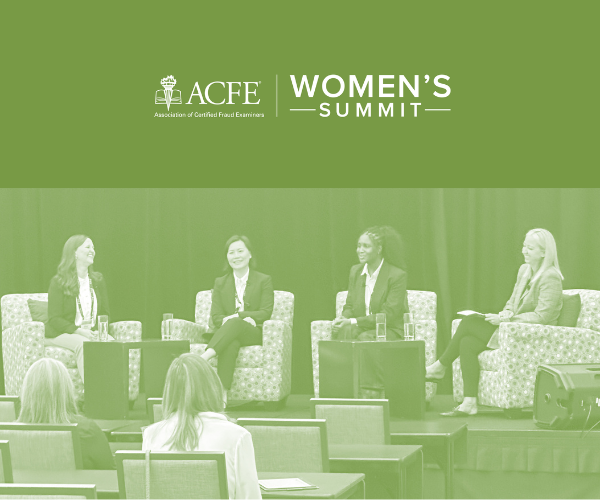
Building Resilient Fraud Risk Assessment Programs: The opening panel set the tone for the day on how fraud risk assessment programs must evolve as organizations face economic pressure, regulatory change and emerging threats. Moderated by Bethmara Kessler, CFE, panelists Anne DeTraglia, CFE, CIA, Stephanie Macrafic, CFE, and Yoko McCarthy, CFE, CISA, CIA, shared strategies for adapting frameworks, monitoring risks and using assessment results proactively to strengthen fraud prevention efforts.
"I would say that the biggest thing I'm seeing as far as how we're responding to [the evolution of AI] now is keeping our assessments dynamic,” said Macrafic. “We're really working hard at cross-function, working together across our industry and across the organization to make sure that everyone has a seat at the table, so we're able to spot things as they change, as they shift, as they evolve, together. Having that cross-collaboration is going to be what keeps us dynamic and moving forward versus a stagnant."
Key takeaway: Resilient fraud programs are built to evolve. Risk assessments should not simply document threats but also actively inform how organizations prioritize and respond to emerging ones.
Strategic Adaptability in Changing Landscapes
How Strategic Adaptability Outperforms Blind Perseverance: In this general session, resilience and adaptability expert Courtney Clark challenged the traditional idea that success comes from simply pushing forward. Drawing on findings from her National Goal Resilience Study, Clark introduced the concept of Productive Persistence, which encourages professionals to stay committed to their goals while remaining flexible in the strategies used to reach them.
"You can only achieve what's achievable,” said Clark. “If your plan for success requires being in 100% control, 100% of the time, that's a bad plan — and it's a recipe for something called toxic positivity. Toxic positivity, the belief that your attitude earns you the right to a specific outcome, can disappoint us, but even worse, it can distract us. It can leave us wasting time on dead ends. That's a problem, because goal commitment is a finite resource.”
Key takeaway: Resilience ≠ perseverance. Professionals should reassess their strategies often and remain willing to pivot as goals, risks and organizational priorities shift.
Investigating Complex Fraud Schemes
Behind the Scenes of a Nursing Home Scam Investigation: DeAnna Debenport, CFE, CIA, Alicia Patterson, J.D., and Steve Fawcett joined moderator Bobbie Paul to reexamine the investigations and prosecution of a $2 million scheme targeting elderly nursing home residents. The session, sponsored by Huron, highlighted the coordination required between investigators and prosecutors, the challenges of working with vulnerable victims and the importance of presenting financial evidence clearly in court.
"If you're doing investigations, one thing to keep in mind: It's always about evidence-based prosecution,” said Fawcett. “You have to look at the evidence, and you have to be willing to be able to change your mind depending where the evidence leads you. You have to follow the evidence. My strategy for investigation is to cast a wide net."
Key takeaway: Behind every fraud case are real victims and complex financial narratives. Effective investigations require collaboration, careful analysis and the ability to communicate findings clearly.
Leadership and Influence in Fraud Examination
Leading Without Authority: Building Influence as a Fraud Examiner: In this panel moderated by ACFE Vice President of Communications, Mandy Moody, CFE, speakers Brandi Steinberg, CFE, CPA, Tope Eletu-Odibo, CFE, and Lucy Tan discussed how fraud examiners often guide decisions without holding formal authority. The conversation focused on building credibility, communicating effectively with stakeholders and using expertise to positively influence outcomes within organizations.
"I'm never looking into the future saying, 'When I get to this position, I will have arrived,'” said Steinberg. “I can only go through today. Today is the only opportunity I get to do today. If I do today poorly, then that's probably going to set up tomorrow to potentially go poorly too. We've got to be focused on what we're doing at the time, regardless of if it's mundane, regardless of if you're reading a 500-page PDF. It's just something that you're like, 'This too shall pass, but let me do this well so that I will be trusted with other things.'"
Key takeaway: Influence in the anti-fraud profession is often earned through credibility, preparation and thoughtful communication.
The Road Ahead for Fraud Detection and AI
Auditing for Fraud, AI and the Road Ahead: A Fireside Chat with Shubhi Rao: Global executive and AI practitioner Shubhi Rao joined ACFE Chief Training Officer, Andi McNeal, CFE, CPA, to reflect on her decades-long career in internal auditing while exploring how AI may reshape fraud detection and compliance in the years ahead. Rao also shared insights on navigating leadership and opportunity within fields where women have historically been underrepresented.
"Trust and verify, the framework itself as we know, is shifting,” said Rao. “The rest of the organization is looking to the governing body, and the governing body themselves have to come up the learning curve to be able to really define for the organization what is fraud, what is verified, what are the guardrails. But if they lack knowledge, where do we start? So, I think one of the things has to be the education of the board themselves at a much deeper level than what we're doing today."
Key takeaway: AI will expand what organizations can do, but governance, oversight and ethical guardrails must still come from people.
Why It Matters
Fraud examination has never been static. As risk evolves, so must the ways professional assess threats, conduct investigations and communicate their findings. The conversations at the 2026 ACFE Women’s Summit reflected that ongoing shift and the expanding role fraud examiners play within their organization.
Events like the 2026 ACFE Women’s Summit provide an opportunity to step back from day-to-day casework and consider the broader trajectory of the profession. Just as importantly, the summit creates space for connection and visibility. Conversations like these help fraud fighters learn from one another, build stronger professional networks and support the continued growth of the anti-fraud community.
