

Fraud Museum Game: Boston’s Most Infamous Fraudster, Charles Ponzi
/
In 1903, Charles Ponzi landed in Boston Harbor as one of more than 850,000 people who emigrated to the U.S. that year. The Italian immigrant was just 21 years old at time, and in search of fortune as he gambled away most of his money on the journey across the Atlantic Ocean. He’d later tell the New York Times that when he first arrived in the U.S., all he had was “$2.50 in cash and $1 million in hopes, and those hopes never left me.”
With those million-dollar hopes, Ponzi eventually amassed a great fortune. He’d also lose it all by concocting a fraudulent investment scheme that would be forever linked to his name.
But before becoming one of the world’s most infamous con-artists, he worked a series of odd jobs. He also lived in Montreal, Canada, for a time. While in Montreal he worked in a bank for Italian immigrants. However, the bank went bust, and a newly-unemployed Ponzi started forging checks. He was caught and sentenced to three years in a Canadian prison.
He supposedly told his mother back home in Italy that he was hired to work for the prison. Upon his release, he traveled back to the U.S., but it wasn’t long before Ponzi found himself on the wrong side of the law once again, this time for helping transport Italian immigrants across the U.S. border. He served two years in a federal prison in Atlanta, Georgia.
Ponzi eventually returned to Boston just as the U.S. emerged from World War I mired in an economic recession. Many people struggling to improve their circumstances in the recession looked to investment opportunities to build wealth. Ponzi, always in search of fortune, capitalized on the spirit of the times with an investment opportunity of his own. He found that opportunity in a letter.
Ponzi’s venture involved international reply coupons (IRC) — vouchers for prepaid reply postage to other countries. From his office in Boston’s North End neighborhood, which he reportedly purchased by pawning his wife’s jewelry, Ponzi plotted his scheme. And for a brief time, Ponzi’s business, the aptly named Securities Exchange Company, became one of the busiest destinations in Boston as eager investors lined up to seek fortune with the “financial wizard” of 27 School Street.
As anti-fraud professionals from around the world attend the 37th Annual ACFE Global Fraud Conference, held this year in Boston, Massachusetts, and virtually, the Association of Certified Fraud Examiners (ACFE) Fraud Museum looks back on the investment scheme that Ponzi devised in the city in 1919.
The ACFE’s Fraud Museum, located at our headquarters in Austin, Texas, features artifacts, memorabilia, documents and other pieces of fraud history collected by ACFE founder and Chairman Dr. Joseph T. Wells, CFE, CPA.
How to Participate in the Fraud Museum Game
To participate in this year’s game, read about Charles Ponzi and his investment scheme to be entered for your chance to win a $250 Amazon gift card. The game begins on Sunday, July 12, and closes on Tuesday, July 14 at 11:59 p.m., Eastern Time.
Only virtual and in-person attendees of the 37th Annual ACFE Global Fraud Conference are eligible to participate. Please read the official rules before submitting your entry. The winner will be notified via email.
International Reply Coupons
While opening his mail one day in 1919, Ponzi found an international reply coupon (IRC) enclosed in a letter from a Spanish correspondent. IRCs were established by international treaty before World War I, enabling people to prepay for return postage from a foreign country. For Ponzi, this coupon looked like a money-making opportunity.
Because Spanish currency was worth less than U.S. currency at the time, Ponzi figured that IRCs could be redeemed in the U.S. for a profit. He bet on buying them from countries with weak currencies and exchanging them in countries with strong currencies would be his ticket to wealth.
Ponzi needed investors for this scheme, so he enlisted sales agents to entice investors for a 10% commission. Those agents recruited other agents who then recruited investors for a 5% commission. Ponzi promised investors 50% interest in 45 to 90 days and boasted that he had networks of sales agents in Europe buying up IRCs in bulk. Ponzi’s financial wizardry turned them into profits. If asked how he was making profits, Ponzi demurred.
The plan seemingly worked: In six months, he had 20,000 investors and $10 million. When word of the opportunity spread, more than 40,000 people clamored for a share of the bounty. His early investors reaped returns, as promised.
Ponzi had turned hopes into millions of dollars, but the business venture wasn’t all it seemed. Ponzi’s scheme was about to crumble.
The Scheme Unravels
By mid-1920 Ponzi was a multimillionaire with a mansion and a chauffeured limo.
He initially received glowing press coverage about his business. A July 1920 Boston Post headline blared: “DOUBLES THE MONEY WITHIN THREE MONTHS; 50 Per Cent Interest Paid in 45 Days by Ponzi—Has Thousands of Investors." The story detailed his rise from impoverished immigrant to wealthy businessman and the IRC business, which raised red flags for some financially savvy observers.
One was ex-fraudster William Franklin Miller. "I cannot understand how Ponzi made so much money in so short a time," he quipped in the New York Evening World. The Boston Post Editor Richard Grozier had his suspicions that Ponzi was running a scheme and dispatched reporters to further investigate.
Ponzi, who enjoyed the news coverage, hired a publicist, William McMasters. McMasters was skeptical of Ponzi’s enterprise, and reviewed Ponzi’s financial records. What McMasters saw spurred him to the Boston Post with a bombshell tidbit of news: Ponzi was insolvent, his profits an illusion. (McMasters received ACFE’s Sentinel Award posthumously in 2011.)
The Post’s exposé sent investors to Ponzi’s office on School Street demanding their money. But the revelations kept coming. Ponzi’s mugshot from the Canadian prison was emblazoned in the Post. To quiet investors, Ponzi agreed to a government audit.
Investigators raided Ponzi’s office and found ample evidence to charge him with 86 counts of mail fraud in August 1920. He served more than 10 years in prison — more than three in a federal prison and seven in state prison. After his release in 1934, he was deported to Italy. He ended up in Brazil, where he died in a charity hospital in1949. He had just enough money to pay for his burial.
Ultimately, Ponzi stole $15 million ($244 million in 2026) from thousands of investors, including fellow Italian immigrants, Boston cops, a banker and even a priest. Ponzi reportedly said of them, "Even if they never got anything for it, it was cheap at that price. Without malice I had given them the best show that was ever staged in their territory since the landing of the Pilgrims!”
An Unsustainable Scheme
The scale of his scheme, and the intense media coverage surrounding it made Ponzi — and investment fraud — a household name. But he didn’t invent it. Before Ponzi there was Sarah Howe and William Franklin Miller.
In 1878, Sarah Howe opened a private bank in Boston and promised thousands of her female investors 8% interest a month to deposit their life savings. She reaped a half-million dollars before the scheme dissolved. In 1899, William Franklin Miller (who recognized Ponzi’s game) launched a scheme in Brooklyn, New York. He claimed secret knowledge of the stock market and told investors they’d earn 10% interest as he pocketed $80,000 a week before his luck ran out.
Investment fraudsters like Ponzi understand that an opportunity to become rich is too powerful for many to ignore, especially when that pitch comes from a charismatic person they trust. Ponzi inspired investors with his rags-to-riches story that appealed to working-class immigrants like him. And while Ponzi schemes generate excitement and optimism, they can only last so long before the money evaporates. Meanwhile, observers will question the scheme’s feasibility, and the perpetrator will shroud the details in an unexplainable boondoggle. Despite the brief life of a Ponzi scheme, many others have attempted it with varying degrees of financial ruin.
Ponzi’s Progeny
More than 100 years after Ponzi’s scheme unraveled, countless fraudsters perpetrated investment scams that lasted longer and were far more financially devastating than anything Ponzi could’ve contemplated.
In the early 1990s, Bernie Madoff, a former chair of NASDAQ, launched a Ponzi scheme that would defraud investors of $65 billion. Initial investors came from Madoff’s social circle, but with his well-regarded reputation in finance, the circle expanded to celebrities, Nobel laureates, universities and charities. Madoff told investors he used a “split-strike conversion” strategy to buy S&P 100 stocks and roll profits into U.S. Treasury bonds. But that’s not what he did. Instead, he ran an elaborate, decadeslong scam paying older investors’ returns with newer investors’ money and pocketing everything else. The scheme only fell apart when the global financial crisis of 2008 spurred investors to get their money back. Of course, Madoff couldn’t meet their demands. Investors lost fortunes, and Madoff was sentenced to 150 years in prison where he died in 2021.
While Madoff was knee deep in fraud, Lou Pearlman was banking on his success as manager of The Backstreet Boys and *NSYNC to coax thousands of Florida retirees to invest in his nonexistent aviation company. Pearlman managed to steal $300 million in a scheme that lasted nearly two decades. He died in 2016 while serving a 25-year prison sentence.
Today’s investment schemers have a few advantages over Ponzi: a global pool of victims courtesy of the internet, cryptocurrency as an investment and artificial intelligence to automate the scheme. According to the FBI in 2025, investment scams were the costliest type of internet fraud with an estimated $6.6 billion in losses. Headline-grabbing schemes using cryptocurrency like 2022’s BitConnect case that bilked investors of $2.4 billion, ensures that fraud fighters will be battling Charles Ponzi’s scheme well into the future.
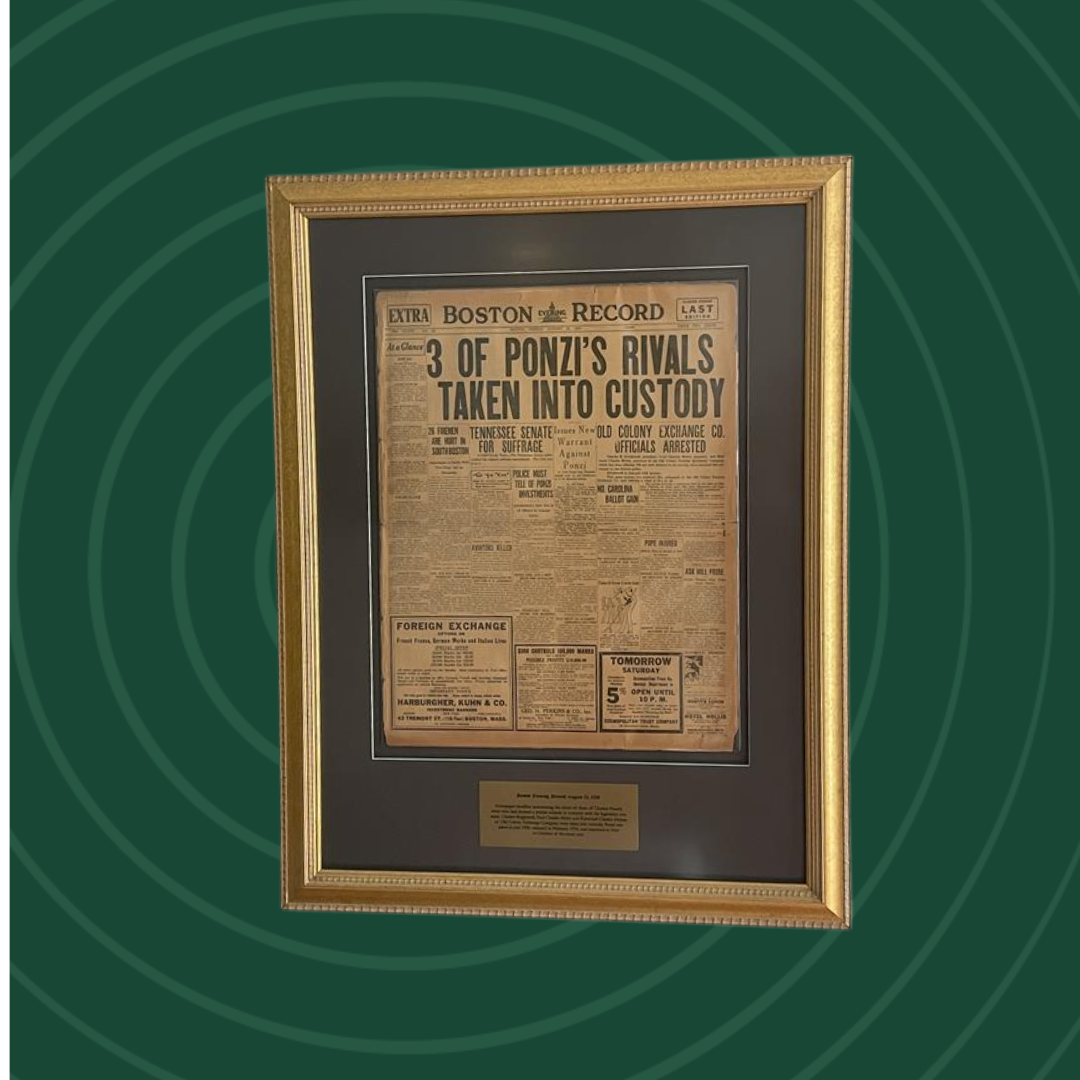
Boston Evening Record, August 13, 1920
Charles Ponzi and the scheme he perpetrated for months were front-page news in Boston on Friday, August 13, 1920, the day after authorities charged Ponzi with 86 counts of mail fraud. Hanging in ACFE’s Fraud Museum is a framed frontpage of the Boston Evening Record. The newspaper reports that Ponzi’s bondsman, who bailed him out of jail, handed him over to U.S. Marshals and into federal custody.
But the Evening Record’s main headline “3 of Ponzi’s Rivals Taken into Custody, Issues New Warrant Against Ponzi,” shows how Ponzi’s Securities Exchange Company captured public attention in 1920. Ponzi’s operation inspired others to start their own “investment companies.” In this case, owners of the Old Colony Foreign Exchange were arrested on suspicion of running a similar scheme. The exchange company reportedly offered investors 100% interest in six months. The Record also recounts the riot that took place outside Old Colony’s office as investors came to get their money back — reminiscent of the investors who lined up on 27 School Street to demand their money back from Ponzi.
-
ACFE Charles Ponzi: Boston’s Most Infamous Fraudster Quiz and Giveaway
TERMS AND CONDITIONS
NO PURCHASE NECESSARY TO ENTER OR WIN. Charles Ponzi: Boston’s Most Infamous Fraudster Quiz and Giveaway is conducted by the Association of Certified Fraud Examiners, Inc. (“ACFE”) and sponsored by Fraud Magazine, 716 West Avenue, Austin, Texas 78701. Fraud Magazine is a publication of ACFE. The Giveaway period will begin on Sunday, July 12, 2026, and run through Tuesday, July 14, 2026. By entering you agree to be bound by these Terms and Conditions.
TO ENTER. Attendees of the 2026 ACFE Global Fraud Conference can enter by submitting, and correctly answering, all the questions in the Fraud Museum quiz (located at https://www.surveymonkey.com/r/DG5KQKW). Entries may be withdrawn by notifying Jennifer Liebman at JLiebman@ACFE.com. Entries must be submitted no later than 11:59 p.m. Eastern Time on July 14, 2026. Only one entry per person. No other form of entry is permitted except as provided above. The ACFE will not be responsible or liable for incomplete, misdirected or late entries.
WINNER. One entrant will be randomly selected to win a $250 gift card. The winner will be randomly drawn from all eligible entries by Tuesday, July 21, 2026. Odds of winning depend on number of entries received. Winner will be notified by email after the drawing.
LIMITATION OF LIABILITY. By entering, entrants release and hold harmless the ACFE, its directors, agents, officers, employees, affiliates and subsidiaries, and their respective directors, agents, officers and employees, from any and all liability or any injuries, loss or damage of any kind arising from or in connection with the contest or any prize won.
SUBSTITUTION OF PRIZES. The ACFE reserves the right to substitute a prize with one of equal or greater value if an advertised prize becomes unavailable for any reason. Winner may waive the right to receive a prize. In the event that a winner so waives their right to receive a prize, or if a winner cannot be contacted by the ACFE within 48 hours of the date and time of selection of that prize, or in the event that a winner is ineligible to win the Giveaway, the ACFE will choose another winner by random selection from all remaining valid entries, and will notify the new winner in the same manner provided above.
ELIGIBILITY. Only attendees of the 2026 ACFE Global Fraud Conference are eligible. The contest is open internationally. Must be 18 years or older to win. Void where prohibited by law. All directors, agents, officers and employees of the ACFE or of any ACFE affiliate or subsidiary are not eligible. Winner may be required to execute an affidavit of eligibility and compliance with contest rules and a liability and publicity release.
TAXES. All taxes and other associated costs and fees on prizes won are the sole responsibility of the winner.
USE OF ENTRANT INFORMATION. Entry constitutes permission to use winner's name and likenesses in ACFE magazines, newsletters, social media and web pages, and to use winner's name and likenesses for purposes of advertising and promotion without further compensation unless prohibited by law. Except for the foregoing, all information supplied by entrants will be maintained by the ACFE in accordance with its established privacy and confidentiality policies.
GENERAL CONDITIONS. This contest is governed by the laws of the Commonwealth of Massachusetts. It is void where prohibited by law. The ACFE is not responsible for lost, interrupted or unavailable network server or other connections, miscommunications, failed telephone or computer transmissions, or any other error of any kind whether human, mechanical or electronic. In the event any portion of this contest is compromised by virus, bugs, nonauthorized human intervention or other causes beyond the control of the ACFE, which, in the sole opinion of the ACFE, corrupt or impair the administration, security, fairness or proper play of the contest, the ACFE reserves the right at its sole discretion to suspend or terminate the contest. The ACFE is not responsible for any problem with a contest entry generated by computer hardware or software malfunction, error, or failure, or by any website failure. The ACFE may terminate the contest or modify it in any manner which the ACFE deems fair and equitable to entrants if it becomes aware of any occurrence which would materially affect the contest’s security or fairness. The ACFE may disqualify or prohibit individuals from participating in the contest if they fail to abide by these official rules. The ACFE’s decisions about the contest are final.
